
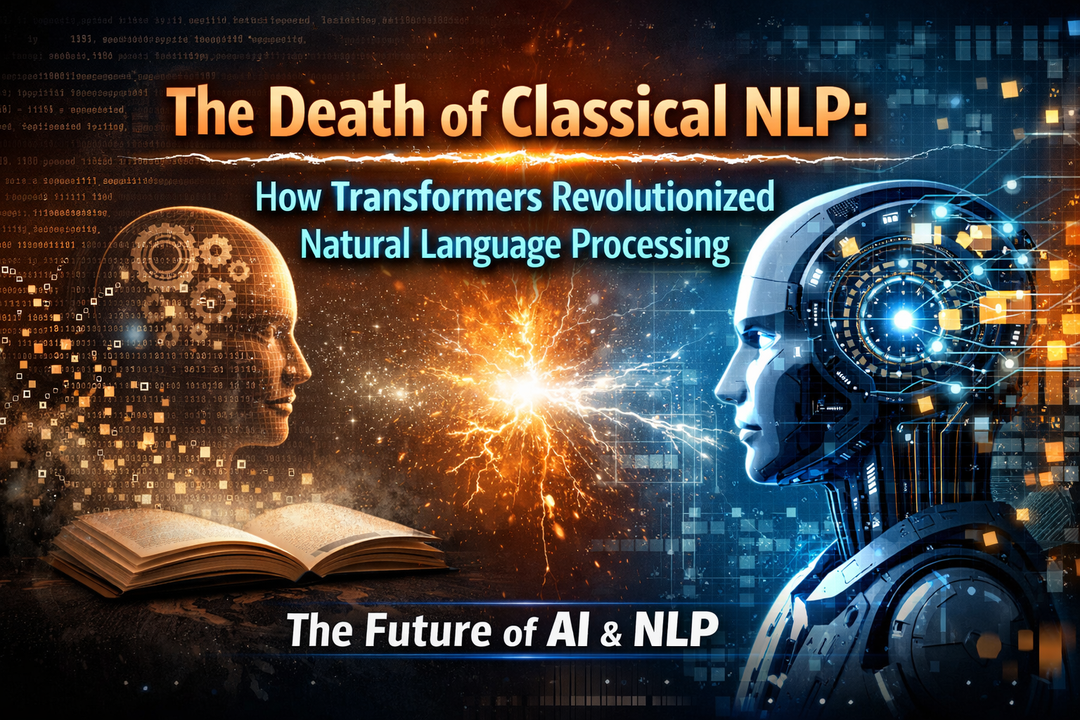
Is Classical NLP Dead? Or Did Transformers Just Change the Game Forever?
For years, classical NLP ruled the world like TF-IDF, n-grams, feature engineering, and carefully tuned pipelines. Building models meant crafting rules, optimizing sparse features, and squeezing performance from limited context.
Then came Transformers.
Models like BERT, GPT, and modern LLMs didn’t just improve NLP — they fundamentally changed how we think about language understanding. Context became dynamic, embeddings became semantic, and transfer learning replaced heavy task-specific engineering. Today, tasks like NER, sentiment analysis, summarization, and conversational AI can be built faster and scaled further than ever before.
But is classical NLP truly dead?
Not exactly. Instead, it evolved. Traditional techniques still matter for efficiency, interpretability, and hybrid production systems — especially where latency, cost, or structured data pipelines matter.
In my recent work building AI agents, LLM guardrails, and NER systems, I’ve seen firsthand how classical NLP knowledge combined with transformer-based models creates powerful real-world solutions.
The future isn’t classical vs transformers — it’s integration.
Discussion (0)
Join the conversation
Sign in to share your thoughts and connect with other readers.