
Reducing LLM Staleness: Integrating Web Search Tools for Fresh, Real-Time AI Agents
Large Language Models are powerful — but they have one major limitation: stale knowledge. Even the strongest models rely on training data snapshots, which means they may miss recent updates, live events, or dynamic domain-specific information.
While building AI agents and chatbot systems, I explored multiple approaches to solve this problem by integrating web search and crawling tools directly into the retrieval pipeline. This blog discusses practical architecture patterns and learnings from my POCs using Vertex AI Search, Firecrawl, Crawl4AI, and Exa.
Why Freshness Matters in AI Systems
Static RAG pipelines using vector databases work well for internal documents, but they struggle when:
Information changes frequently (finance, news, product updates)
Real-time context is required
External web sources must be incorporated
Without freshness mechanisms, chatbots risk hallucinating outdated facts or providing irrelevant responses.
Core Strategies for Web Integration
1. Live Web Search Retrieval
One approach is integrating semantic web search tools like Exa or Vertex AI Search into the agent pipeline. Instead of relying purely on stored embeddings, the agent dynamically queries the web during inference.
Typical flow:
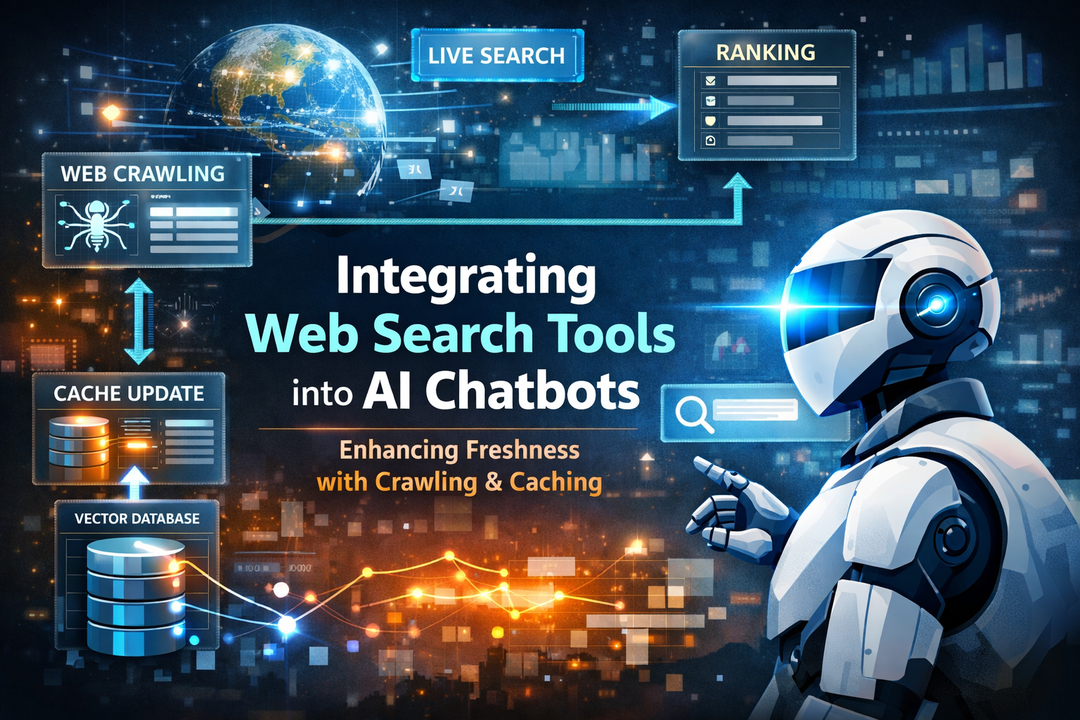
User Query → Agent decides tool usage → Web search API → Content extraction → RAG context → LLM response
This ensures the model retrieves current information when required.
2. Intelligent Web Crawling
For predictable domains or curated knowledge sources, crawling becomes more efficient than live search.
During experimentation, Firecrawl stood out due to:
Built-in ranking and filtering
Structured content extraction
Strong handling of modern web pages
Rather than crawling in real-time, periodic crawling (e.g., weekly caching) reduces latency while maintaining freshness.
3. Hybrid Caching Architecture
A highly effective design pattern combines:
Scheduled crawling (weekly/daily updates)
Cached embeddings in vector databases
Live web search fallback for unseen queries
This reduces cost and response latency while maintaining accuracy.
Example architecture:
Crawler → Content preprocessing → Embedding pipeline → Vector DB cache
Agent → Query classification → Cached retrieval OR Live web search → LLM
4. Agent-Based Tool Selection
Using agentic frameworks (LangChain-style or custom orchestration), the chatbot can dynamically decide:
When to use internal knowledge
When to trigger web search
When to rely on cached crawled data
This prevents unnecessary API calls while ensuring high-quality responses.
Tool Comparisons from Practical POCs
1. Vertex AI
Strong integration with Google ecosystem
Reliable search quality
Useful for enterprise-scale retrieval workflows
2. Exa
Designed for AI-native search
Semantic-first querying
Works well for research-style tasks
3. Crawl4AI
Flexible crawling pipelines
Good for structured experimentation
Requires more tuning for production pipelines
4. Firecrawl
Best performance in freshness during testing
Internal ranking improves content quality
Ideal for scheduled crawling and caching strategies
Key Lessons Learned:-
Real-time search is powerful but expensive — hybrid strategies work best.
Crawling with periodic refresh cycles balances latency and freshness.
Tool orchestration via agents significantly improves response quality.
Ranking and filtering mechanisms in crawling tools greatly affect downstream LLM performance.
Final Thoughts
Freshness is not just about accessing the internet — it’s about building a smart retrieval architecture that balances cost, speed, and relevance.
As AI systems move toward agentic workflows, integrating intelligent web search and crawling pipelines will become a core design requirement for production-grade chatbots.
Discussion (0)
Join the conversation
Sign in to share your thoughts and connect with other readers.